
How Singapore SMEs Can Test the Malaysian Market Before Expanding
Expanding your Singapore business to Malaysia starts with a controlled 90-day pilot to test product demand, localized pricing, and cross-border fulfillment before committing major capital. Based on search interest in trending consumer categories like sneakers or headscarves, this step-by-step market validation strategy highlights how leveraging e-commerce platforms like Shopee and Lazada alongside Enterprise Singapore MRA grant support reduces overseas risk. Partnering with Laxla for integrated market research, digital storefront operations, and coordinated regional logistics gives businesses actionable data to confirm margins and customer retention before scaling their physical presence.
Expanding from Singapore into Malaysia can look like a natural next step. The two markets are geographically close, have strong business ties and share many consumer similarities. Enterprise Singapore describes Malaysia as one of Southeast Asia’s economic powerhouses and notes that Malaysians are generally familiar with Singapore brands because of the close relationship between the two countries. Malaysia had a population of 35.6 million in 2024, a GDP of US$422.23 billion and GDP growth of 5.1%. Singapore’s bilateral trade in goods with Malaysia reached S$145.04 billion in 2025.
That makes Malaysia attractive for Singapore SMEs. The problem starts when a business treats market entry as a commitment instead of a test. Renting a local office, purchasing large amounts of inventory or building a full overseas operation before understanding Malaysian demand can tie up cash very quickly. A better starting point is a controlled cross-border pilot where you can test your products, pricing, customer response, fulfilment and margins before deciding how far you want to go.

Think of the first 90 days as a business experiment. The goal is to answer practical questions: Which products attract Malaysian buyers? What price feels acceptable in Malaysia? Which channels generate real interest in Malaysia? Can your fulfilment process deliver consistently in Malaysia? Are customers coming back to Malaysia? Once you have those answers, your next decision becomes much clearer. Should you increase inventory, expand your product range, work with local partners, launch pop-ups or consider a physical presence?
How to Find What Is Always Trending in Malaysia
Before choosing a product to sell in Malaysia, start by identifying categories with sustained and growing search demand. The goal is not to follow a short-lived viral trend. It is to find products that Malaysians search for repeatedly, with search intensity increasing over time. This gives Singapore SMEs a stronger starting point for market validation.
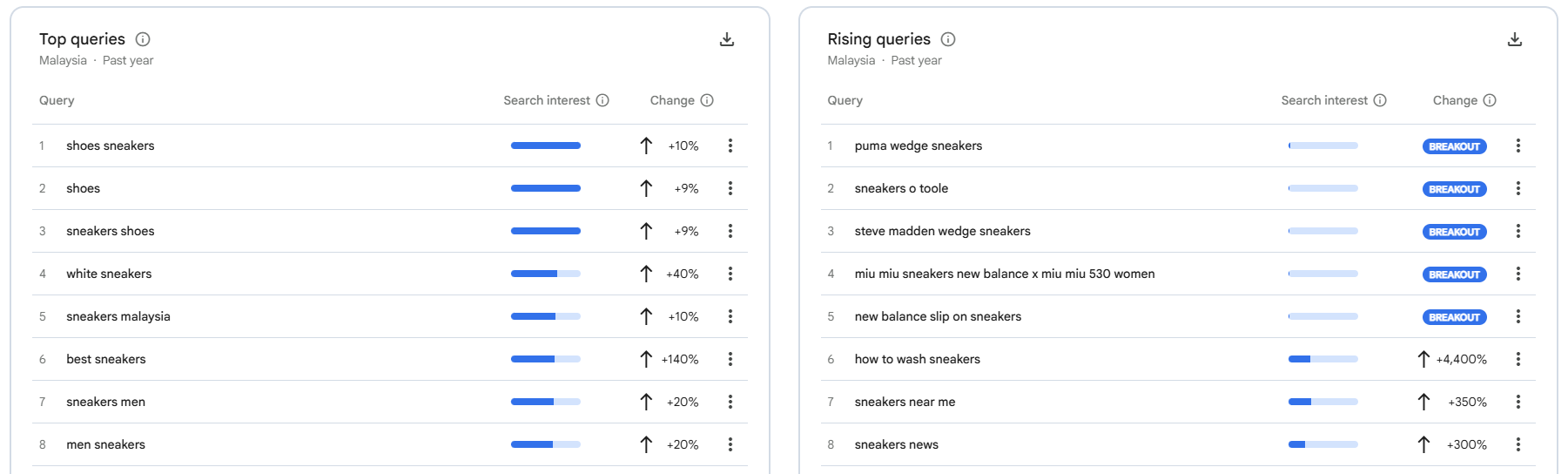
For example, sneakers are a category with consistent consumer interest. Searches related to sneakers can grow year after year, while specific terms such as “how to wash sneakers” may experience significant spikes of more than 4,400% in search interest. If the data shows strong demand for sneakers and sneaker care, a business could enter the market with a unique shoe design, specialised sneakers or even a shoe-cleaning product. The opportunity is not limited to selling the main product. Search behaviour can reveal related needs that are easier to serve.
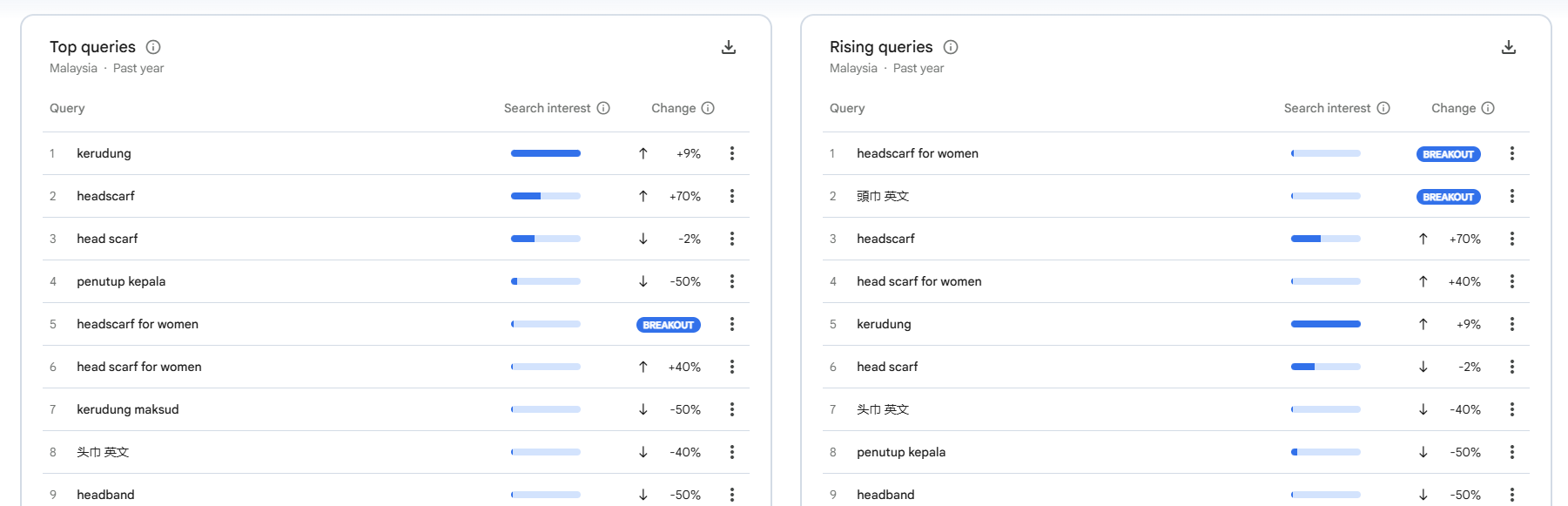
Headscarves are another example of a category with recurring demand in Malaysia. If search intensity for headscarves continues to increase, a Singapore business could test products such as modern headscarves, premium fabrics, easy-to-style designs, sports headscarves, or complementary accessories. The key is to identify a clear customer need and offer something differentiated rather than simply listing another generic product.
A practical trend-validation process should examine:
- Whether search interest has increased consistently over several years
- Which related keywords are growing fastest
- Whether the demand is seasonal or present throughout the year
- What customers are asking about, such as cleaning, styling, sizing or quality
- Which products already dominate the market
- Whether there is an opportunity to offer a better design, material, price or customer experience
Google Trends, marketplace search data, social media discussions and keyword research tools can help reveal these patterns. For instance, a business may discover that Malaysians are not only searching for “sneakers”, but also “how to wash sneakers”, “white sneaker cleaner”, “comfortable sneakers for walking” or “sneakers for work”. Each related search can point to a different product or marketing angle.
Malaysia already offers several online routes for Singapore businesses. Enterprise Singapore highlights e-commerce as an important opportunity and identifies platforms such as Lazada, Shopee and Zalora as potential landing points. Opening an online channel can give an SME access to Malaysian customers without immediately committing to a physical retail operation.

Platforms can also remove some of the operational barriers. For example, Shopee’s Singapore-to-Malaysia Direct Selling Programme allows Singapore-based sellers to sell directly to Malaysian buyers through Shopee Malaysia, with integrated logistics and payment solutions. This shows how technology can reduce the complexity of entering another market. However, the platform itself is only one part of the expansion equation. Your product selection, pricing, brand presentation, customer experience, and fulfilment process still determine whether Malaysian customers actually buy and return.
The question is: “How do I sell cross-border?” A stronger question is, “What are Malaysians already searching for, and how can my business solve that need in a better or more distinctive way?” A marketplace can provide access to customers, while your business still needs to connect search demand, product development, marketing, and fulfilment.

Laxla approaches this through an integrated ecosystem:
- Market trend research
- Product development or selection
- Laxla platform
- Coordinated cross-border fulfilment
- Customer
We help businesses:
- Identify promising Malaysian demand signals
- Develop or position suitable products
- Manage e-commerce operations
- Coordinate regional promotion
- Fulfil orders
This allows a Singapore SME to test products such as unique sneakers, sneaker-care solutions, headscarves or other high-interest categories before committing to a larger expansion, while entering Malaysia with evidence, understanding customer preferences and building a foundation for sustainable regional growth.
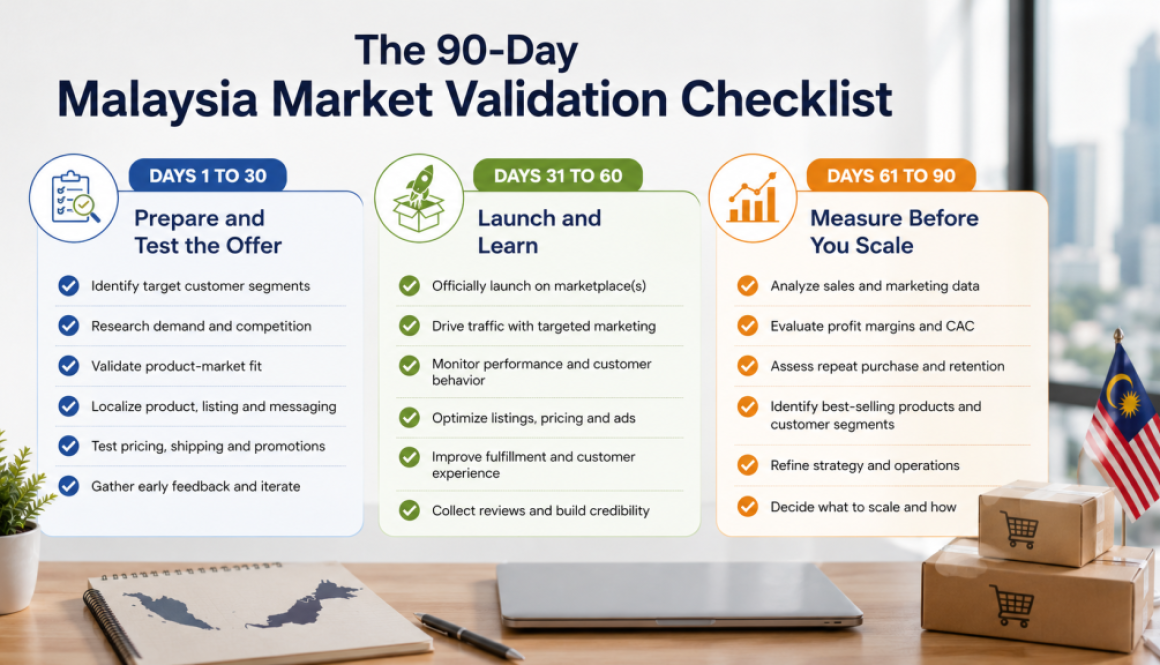
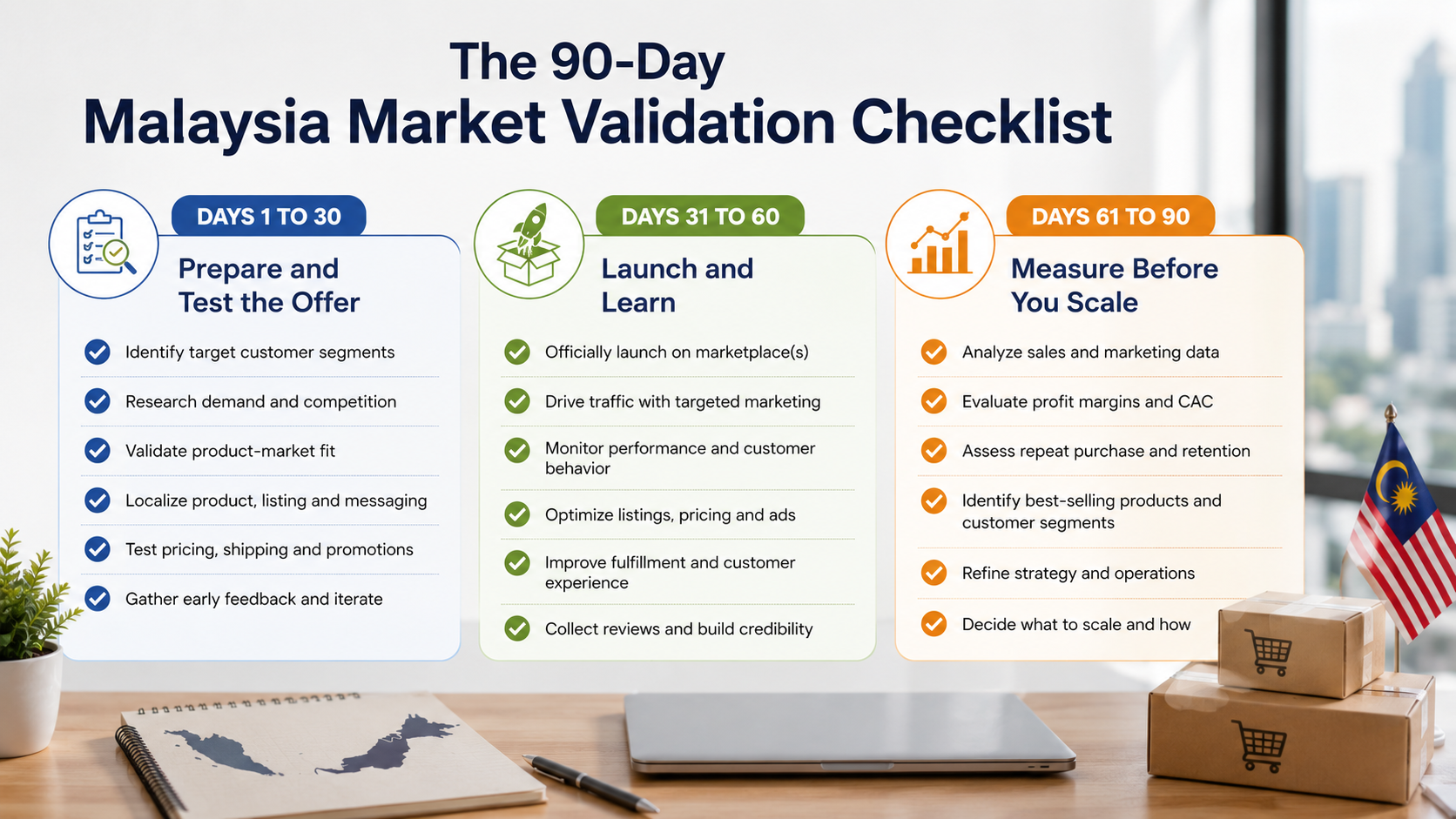
The 90-Day Malaysia Market Validation Checklist
Days 1 to 30: Prepare and Test the Offer
Start small. Select a limited number of products that have a clear reason to appeal to Malaysian customers. Review your Singapore sales data, product margins, and customer feedback to identify the strongest candidates. Then localise the pricing, product descriptions, images, and marketplace listings for Malaysia. Your first question should be simple: Does the Malaysian customer understand the value of this product at this price?

This stage should also examine fulfilment before order volume becomes significant. Estimate shipping costs, delivery timelines, packaging requirements, and potential returns. A product may sell well at first glance, but high fulfilment costs can quickly destroy the margin. This is where a cross-border pilot becomes useful because you can test the economics with controlled order volume rather than committing significant inventory upfront.
Days 31 to 60: Launch and Learn
Once the basic setup is ready, launch the selected products through your chosen online channels. Use marketplace promotion, social content and creator partnerships where appropriate to generate initial traffic. At this stage, avoid judging the campaign only by views or clicks. Look at product page visits, add-to-cart activity, conversion rate, order value and customer questions.

Customer feedback is especially valuable during this period. Are Malaysian shoppers asking about product quality, delivery time, sizing, ingredients, or warranty? These questions reveal gaps in your positioning. If customers repeatedly hesitate over the same issue, adjust the listing, packaging, offer, or communication instead of simply spending more on advertising.
Days 61 to 90: Measure Before You Scale
The final 30 days are about making a business decision. Review sales, returns, fulfilment costs, gross margins, customer acquisition costs and repeat demand. Compare the results against your original assumptions. A product generating orders may still be unsuitable for expansion if the margin is too thin or fulfilment is unreliable.

Then decide what comes next. Strong results could justify increasing inventory, adding more products or investing in Malaysian marketing. You could also explore pop-ups, distributors, strategic partners or a local presence. Weak results do not necessarily mean Malaysia is the wrong market. They may indicate that the product, pricing, positioning or channel needs another test.
For eligible Singapore SMEs, the Market Readiness Assistance (MRA) grant may also help offset certain overseas market promotion, business development and market-entry costs. From 1 April 2026, eligible local SMEs can receive support of up to 70% of eligible costs, capped at S$100,000 per company per new market, subject to the scheme’s eligibility and application conditions.
Validate First, Then Decide How Far to Go
Malaysia can be an attractive first overseas market for Singapore SMEs, especially because of its proximity, established commercial relationship with Singapore and growing online-to-offline consumer environment. Enterprise Singapore specifically highlights Malaysia’s familiarity with Singapore brands and its opportunities across lifestyle and consumer sectors.
The bigger question is whether your business is ready to serve that market profitably. Before investing in an overseas office, warehouse or significant inventory, use 90 days to find out what Malaysian customers actually want. Test the product, price, promotion, fulfilment and customer experience together. This gives you evidence that can guide your next investment.
Laxla’s role is to help connect those moving parts. Beyond managing e-commerce operations, we help businesses position products, coordinate cross-border fulfilment, improve marketplace presentation and connect the operational pieces required for regional growth. If you are considering Malaysia, comment “MALAYSIA PILOT” below. We can use the discussion to understand your business and provide information about our Malaysia Cross-Border Market Validation Pilot, including a proposed 90-day pilot scope, channel mix and readiness checklist.
Q&A
Can I sell in Malaysia from Singapore without opening a Malaysian office?
Yes. Online cross-border selling can allow Singapore businesses to reach Malaysian customers without immediately establishing a physical office. The right approach depends on your product, fulfilment model, regulations and target customers. Enterprise Singapore identifies online channels as one route for Singapore businesses entering Malaysia.
How much inventory should I send to Malaysia?
There is no universal quantity. For a first market test, consider using a controlled inventory level based on expected demand, product shelf life, fulfilment costs and replenishment time. The purpose of a pilot is to learn before making a larger inventory commitment.
Is a Marketplace enough to expand into Malaysia?
A marketplace can provide an important sales channel, and programmes such as Shopee’s Singapore-to-Malaysia Direct Selling Programme can simplify some operational requirements. However, long-term expansion also depends on product positioning, pricing, customer experience, fulfilment and brand development.
Can the MRA grant support Malaysia expansion?
Eligible Singapore SMEs can apply for MRA support for overseas market promotion, business development and market-entry activities. From 1 April 2026, support can reach up to 70% of eligible costs for local SMEs, with a cap of S$100,000 per company per new market, subject to eligibility and application requirements. Applications must also be submitted before the project starts.
What should I test during the first 90 days?
Focus on five areas: demand, pricing, conversion, fulfilment and profitability. If customers are interested but do not purchase, investigate the offer or positioning. If sales are strong but margins are weak, review pricing and fulfilment. If customers buy and return, you may have evidence that Malaysia deserves a larger investment.