Key Summary
Pinduoduo is becoming more visible in Singapore, giving price-sensitive shoppers another reason to compare prices before they buy. For Singapore SMEs, the arrival of another low-price competitor may create pressure to reduce prices, but constantly cutting prices can quickly damage margins and make it harder to invest in product quality, customer experience, and growth.
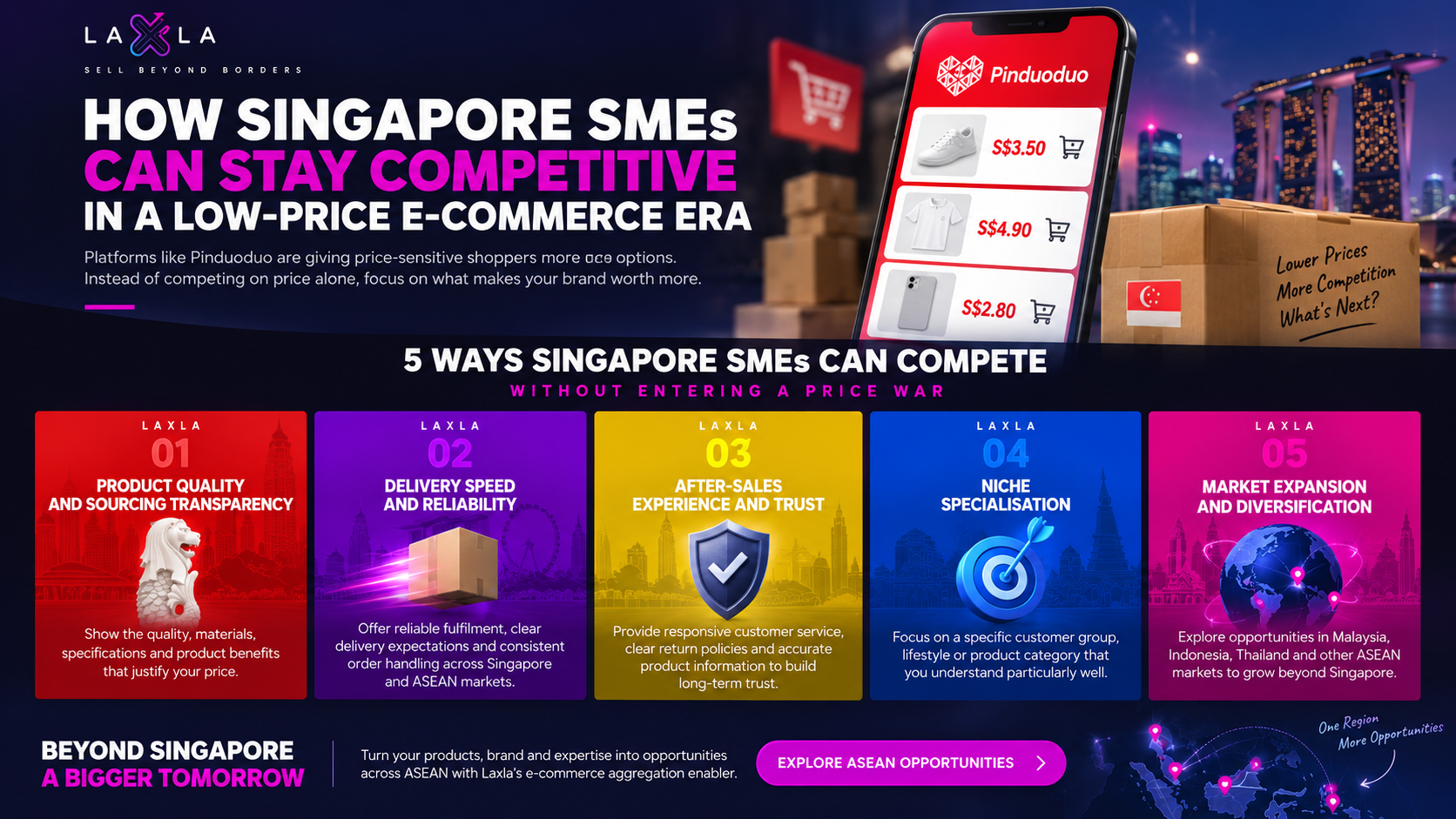
Instead of asking, “How can I become cheaper?”, SMEs should ask, “What can I improve so customers have a reason to pay more?” From product quality and reliable delivery to niche positioning and ASEAN expansion, there are several ways Singapore sellers can compete without entering a price war they may struggle to win.
Introduction
If you sell online in Singapore, you have probably noticed a new name showing up in your ad feed and on your competitors’ price tags: Pinduoduo. The Chinese e-commerce platform has been running social media campaigns here since late 2025, and it quickly climbed to become the most downloaded shopping app on the Apple App Store in Singapore, ahead of its sister platform Temu and just behind Shopee. For a platform that barely existed in local conversation a year ago, that is a fast rise.
The instinct for many SMEs, when a cheaper competitor shows up, is to lower their own prices to keep up. It feels like the safest move. But price is a game that almost never favours the smaller player, because there is always someone with a bigger factory, a longer supply chain, or deeper investor backing who can go lower still. Pinduoduo did not become one of China’s largest platforms by accident. It built an entire model designed to win exactly this fight.
This blog looks at what Pinduoduo and Temu are actually doing in Singapore, what their low prices are quietly built on, and why Singapore SMEs are better off building something a price war cannot touch. We will also open the floor for you to share your own experience, because pricing pressure is a conversation worth having openly, not just something to react to alone.
The Pinduoduo Case
Temu has already made itself known in Singapore since launching here in 2023. It is backed by PDD Holdings, the same parent company behind Pinduoduo, and it runs on a similar playbook: connect sellers directly with consumers and strip out as many middlemen as possible to keep prices low. For sellers considering Temu, the cost structure varies significantly depending on the model. On the fully managed option, Temu takes care of pricing, shipping, and customer service once products reach its warehouse, with an effective seller cost of roughly 2% to 5% built into the negotiated supply price. On the semi-managed option, sellers keep more control but pay an 8% to 15% referral commission, a monthly subscription fee, payment processing charges, and their own shipping and returns. Treating Temu as a flat, cheap marketplace across the board is a common mistake, since that low figure only applies to one of the two models.
Pinduoduo’s push into Singapore follows a similar logic, and it is already working. NTU economist Asst Prof Chua Yeow Hwee has pointed out that Pinduoduo’s free shipping on single items is drawing in price-conscious shoppers who are increasingly willing to wait longer for delivery in exchange for a lower price. Importantly, he also noted that local e-commerce competition is expected to remain segmented by price, delivery speed, reliability, and shopping experience, which means price is only one battlefield, not the whole war. The scale of the price gap is genuinely hard to compete with. A regional price comparison found a pair of slippers priced at RM3.50 on Pinduoduo against RM7.22 on Shopee and RM8.35 on Lazada, with a similar gap on basic items like T-shirts. No Singapore SME running a real business, paying real staff, and sourcing through normal channels can profitably chase numbers like that.

Here is the part that matters most: those prices come with a cost that does not show up at checkout. Research on Pinduoduo’s low-price model found the platform received 428,300 complaints in a single year, the highest of any e-commerce platform in China, largely tied to counterfeit goods and product defects linked to its reliance on small manufacturers and leftover stock with limited merchant oversight. In a survey of Pinduoduo users, 76.4%named low prices as the platform’s biggest strength, while only 3.73% rated its product quality as good. This is not a new problem either. As far back as 2018, Chinese brands publicly called out Pinduoduo for selling counterfeit goods, with television maker Skyworth Group demanding the platform stop selling fake versions of its products, and one of China’s largest publishing houses taking legal action after Pinduoduo listings were found selling pirated books at steep discounts. The pattern is consistent: the lower the price, the harder it becomes to guarantee what customers actually receive.
What Should Singapore SMEs Do Instead of Lowering Their Prices?
If a competitor lowers its price, your first response should be to examine your value proposition.
1. Product Quality and Sourcing Transparency
Customers need to understand why your product deserves its price. Show the quality of your materials, sourcing, specifications, packaging, certifications where applicable, and product benefits.

For e-commerce sellers, product images and descriptions are especially important because customers cannot physically inspect the product before purchasing.
2. Delivery Speed and Reliability
Some customers are willing to wait for a cheaper product. Others value certainty.
Reliable fulfilment, clear delivery expectations, and consistent order handling can become part of your competitive advantage. This is especially important when selling across Singapore and neighbouring ASEAN markets, where fulfilment requirements can vary.
3. After-Sales Experience and Trust
A low price can encourage the first purchase. A good experience can encourage the second.
Clear return policies, responsive customer service, accurate product information and proper communication help reduce customer uncertainty. For SMEs, building trust can create a stronger relationship than competing through discounts alone.
4. Niche Specialisation
The more identical your product looks to hundreds of other listings, the easier it becomes for customers to compare you by price.

A clear niche can change that. Focus on a specific customer group, business need, lifestyle, product category, or problem that you understand particularly well.
The goal is to make customers ask, “Which seller is right for me?” instead of only asking, “Which seller is cheapest?”
5. Market Expansion and Diversification
If competition becomes intense in Singapore, consider whether your product could serve customers in Malaysia, Indonesia, Thailand, or other ASEAN markets.
Southeast Asia’s e-commerce growth creates opportunities beyond Singapore. However, expansion should be tested carefully. Businesses should validate demand, review pricing, adapt product presentation, and plan fulfilment before committing significant resources.
This is where cross-border e-commerce can become a growth strategy rather than simply another sales channel.
Closing: Do You Really Need to Join the Price War?
The question Singapore SMEs should ask is simple: “What can I improve so customers have a reason to pay more?” If a competitor sells for $20 while you sell for $30, immediately dropping to $19 may win one sale today while putting more pressure on your margins tomorrow. A stronger approach is to understand what makes your product worth $30 and communicate that value clearly through better product quality, packaging, customer experience, reliability, and positioning.
At Laxla, we help Singapore SMEs connect the different parts of cross-border e-commerce, from product and packaging preparation to e-commerce listing, regional promotion, fulfilment, and ASEAN market expansion. If your business is facing stronger price competition, we can help you look beyond lowering your price and identify opportunities to strengthen your product and explore new markets across ASEAN. What would you improve first: your product, delivery, customer experience, niche, or market reach? Comment “LOW PRICE” and share your business with us.
Q&A
Is Pinduoduo the same as Temu?
No, but they are closely related. Temu is the international-facing platform launched by PDD Holdings, the same parent company that owns Pinduoduo. Temu was built using a similar low-price, direct-from-supplier model.
Should Singapore SMEs lower their prices to compete with Pinduoduo?
Generally, no. Pinduoduo’s prices are built on a supply chain and cost structure most local SMEs cannot replicate. Competing on price alone usually leads to a race that favours whoever can go lowest, which is rarely the smaller business.
How can Singapore sellers compete with low-price e-commerce platforms?
Singapore sellers can differentiate through product quality, sourcing transparency, reliable fulfilment, after-sales service, customer trust, and specialised positioning. Expanding into suitable ASEAN markets can also create additional opportunities.
Why is product quality important when competing on price?
A low price can attract attention, but customers also consider whether a product is reliable, suitable for their needs, and worth buying again. Communicating quality clearly can help a business create value beyond the price tag.
Can Singapore SMEs expand into ASEAN without competing on the lowest price?
Yes. Businesses can identify specific customer segments and markets where their product has a stronger fit. Malaysia, Indonesia and Thailand can provide potential opportunities, depending on the product, pricing, competition and fulfilment requirements.
How can Laxla support Singapore SMEs with cross-border e-commerce?
Laxla supports businesses with product and packaging preparation, e-commerce product listing and presentation, regional promotion, fulfilment and cross-border coordination. This helps SMEs connect the operational pieces required to explore and grow across ASEAN.